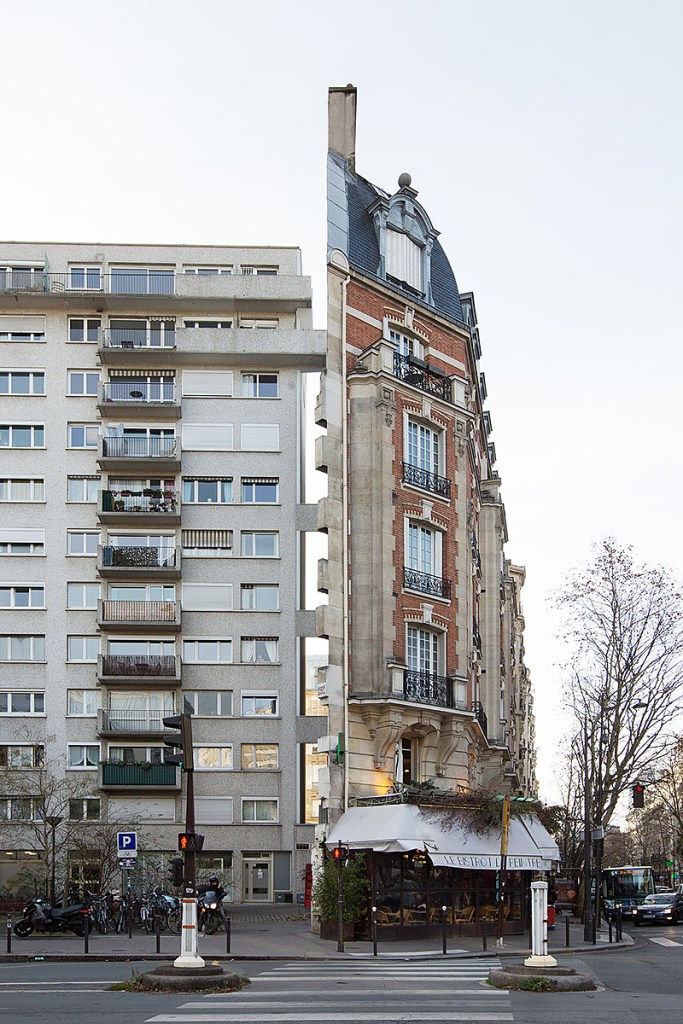
You either love or hate the uniformity of Parisian buildings, where about 60% of what you see is characterized as the classic architectural style “Haussmann”. The typical six story creamy stone facades with wrought iron details are as synonymous to the idealized image of Paris as the Eiffel Tower and baguettes. Sure the city could use a bit more PIZAZZ but there are quite a few architectural oddities if you know where to look for them. My favorites are the deceptively skinny buildings you can find in the 15th, 12th, and 5th arrondissements Known in French as “façades bègues”.
Rue Gay Lussac, Paris 5
Depending on the angle you are viewing them from, you might have the impression they are part of a Hollywood-esque movie set or the homes of ex-Victoria Secret models or Matthew McConaughey circa ‘Dallas Buyers Club’ until you change your perception and realize all is not as it seems.
Rue Monge Paris 5
There are a few reasons for this! 1. The architect simply had to make do with a narrow piece of land
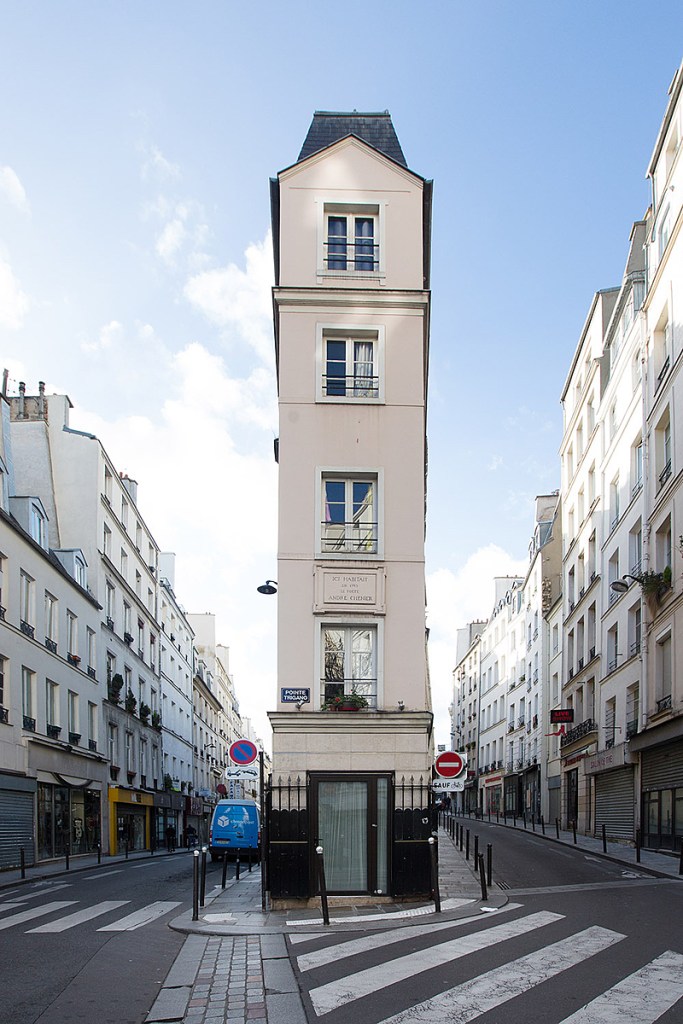
Rue Beauregard, Paris 2. Photo Paris Zig Zag. This building dates to the second half of the 17th century and is known as the Pointe Trigano. It is considered the narrowest building in Paris
2. There used to be another building or structure that was previously adjoined but has since been removed, leaving the existing building awkwardly exposed.
Rue Charonne Paris 12. Photo Paris Zig Zag
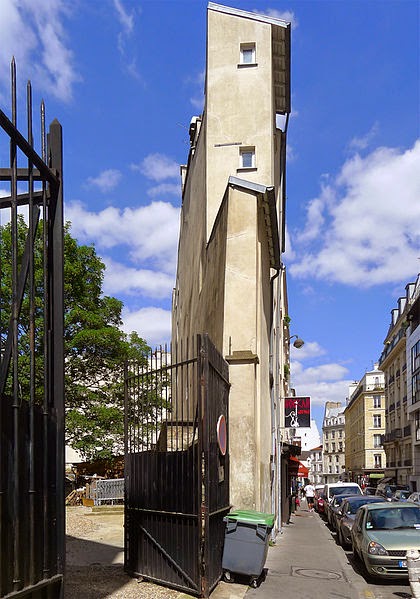
One perfect example is in the Latin Quarter at 14 rue Thouin, where this curious building dating from 1688 once leaned upon the fortified defensive wall built by Philippe Auguste that encircled Paris from 1190 until it was mostly destroyed in the late 17th century. If you can manage to sneak to the back when the gate is open, it’s possible to still see remnants of this wall today.
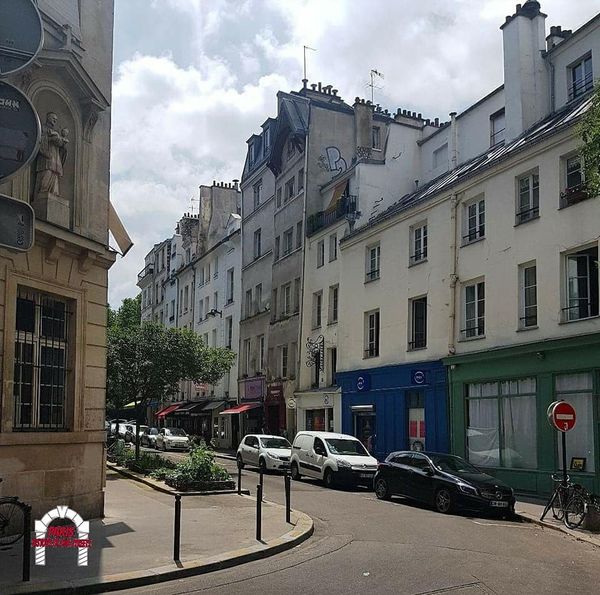
The Rue Boutebrie has been around since the 13th century and began as Rue Erembourg de Brie, after a noble who lived there. There are two very interesting and old things on this street that make this girl giddy with glee.
2020
1899
1. If you’re an Original Gansta Paris History of our Streets faithful follower, you already know that the house at number 6 is OLD AS DIRT (not even the owner of the restaurant on the ground level knew the building’s age) because it has the signature gabled roof/maison à pignon that can only mean it was constructed before the 17th century. (These kinds of buildings with roofs facing the street were forbidden to be built after 1667 when King Louis XIV deemed them a fire risk. There are only about 20 or so of these old sexy beasts still in this area of Paris)
2. Thanks to the nice guy at Grains Nobles, I was able to breech the locked entryway at number 8 to take a peek at the historic treasure waiting in the hallway. Like a medieval prostitute with a bad case of the clap, this staircase has been AROUND.
Just a typical entranceway to a 16th century building right? WRONG!
This wooden sculpted masterpiece has been in this building since the late 16th century and was classified a historic monument in 1925. It is in incredible condition- it appears to have been resurfaced recently because I find it hard to believe anything this smooth and shiny could be 400+ years old.
The staircase today compared to a sketch done in 1884 by the artist Jules Adolphe Chauvet.
I walked it up to the 5th floor hoping I could run into one of the apartment owners (whom I would automatically befriend because who doesn’t love a girl only 3 years past her prime with a passion for history and nice long legs? They would then invite me into their 16th century home where we would share a café and count the inevitable cockroaches who skitter past that undoubtedly live in their walls) but alas, no one was home.
Side Note: Gonnorhea was referred to as the clap before it was even Gonnorhea; described in medevial times as a clapping burning sensation during urination.
On the 7th of February 1820, the body of Louis-Benoit Zamor was found by his neighbor in his 2nd floor apartment located in the Rue Perdu (today rue Maitre Albert, right by Notre Dame).
Where Zamour lived and died
The writer Jacques Levron remarked that, “He lived in a small, sordid room, disliked by everyone. His body was thrown in a communal pit and no one came to his funeral.”
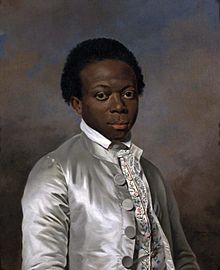
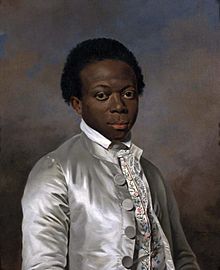
Louis-Benoit Zamor
Zamour spent much of his childhood at Versaille where he lived as the adopted son AKA human slave of Madame du Barry, famous maîtresse-en-titre to Louis XV. Born in Bangladesh around 1762, he was captured as a child by English slave traders then bought to France where he was given as a gift to the king’s favorite plaything. Jeanne Bécu, the former call girl turned Countess who gradually moved up in rank as she moved around the beds of her many lovers, until peaking with Louis XV.
Madame du Barry et le page Zamore painted by Jean-Baptiste André Gautier-Dagoty
But alas, the higher one climbs by giving sexual favors, the farther there is to fall, and du Berry found herself under the blade of the guillotine begging the executioner for “encore un petit moment!” in 1793. Seeking vindication for the years he spent serving her hot chocolate (daily, apparently at 9am) and dressing up to entertain her as a savage African (he was Indian),
Portrait of Du Barry done by Élisabeth Vigée Le Brun, 1782
However payback is a bitch, and Zamour himself threw Du Barry under the Revolutionary Bus when he testified against her 1792. He acknowledged that even if du Berry treated him to a lavish lifestyle at the French royal court, she humiliated him and made jokes at his expense. She may have baptized and educated him, but he was little more than her human pet. Eventually, she would find herself under the guillotine blade, begging for her life. Unfortunately for Zamour, revenge must not have been so sweet because he found himself imprisoned during the Reign of Terror for several weeks when he was accused of treason as well.
Image of Madame du Barry and Zamour from the Sophia Coppola film Marie Antoinette
He miraculously survived and post-Revolution, he came to the Latin Quarter of Paris, where he was known as a bitter old man. No shit! Having received a valuable education at Versaille, he worked as a tutor but was known to physically abuse the students he worked with. Despite the legacy he was left with, I really think there is more to Zamour than what we know.
Have you ever heard of Charlotte Corday- the murderess affectionately named The Angel of Assassination?
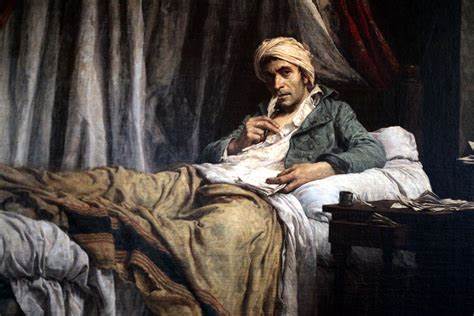
During the Reign of Terror, (the time during the French revolution when things were getting a little bananas) the radical, left wing Jacobin journalist Jean Paul Marat was using his popular newspaper L’Ami du Peuple (Friend of the People) to attack and denounce influential conservative leaders- ultimately sending anyone whose name appeared in his highly influential paper to their death with the flick of his quil.
Marat Lucien-Étienne Mélingue, 1879
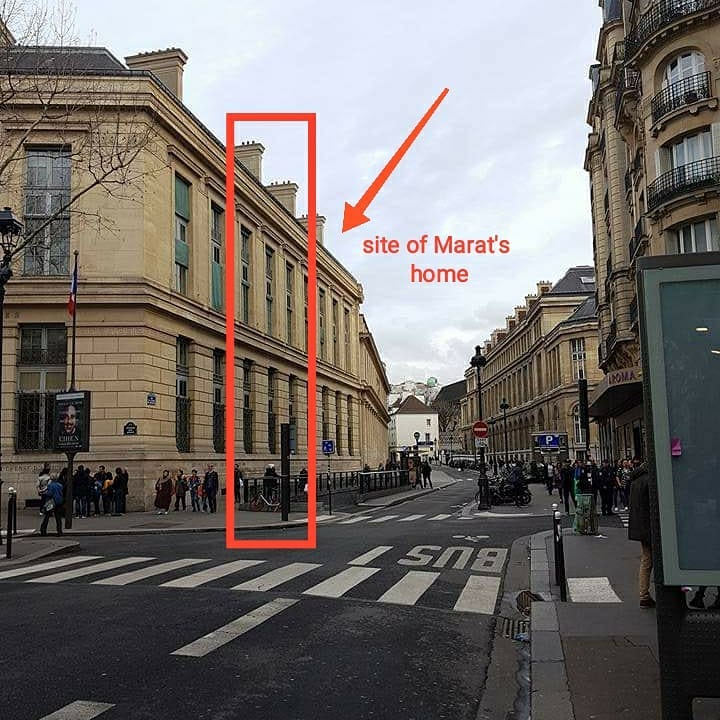
Charlotte, a young woman of 26 influenced by Girondin ideas and wanting to prevent an all out civil war, decided to take matters into her own hands and end the massacre of so many caused by the words of Marat. As they say, snitches get stitches. Or in this case, shanked by a kitchen knife while in the bath. Acting alone, she made her way into Paris from the Normandy region, bought herself a dagger, (check out the link below to see where this was) and went to see Marat himself at his residence at 30 rue des Cordeliers (present day 18 rue de l’Ecole de Médecine)
Comparison to the current view where Marat was assasinated. His building was destroyed in 1876. It is a common misconception that his apartment is the one with the turet on the corner. Photos courtesy of c.corday.free.fr
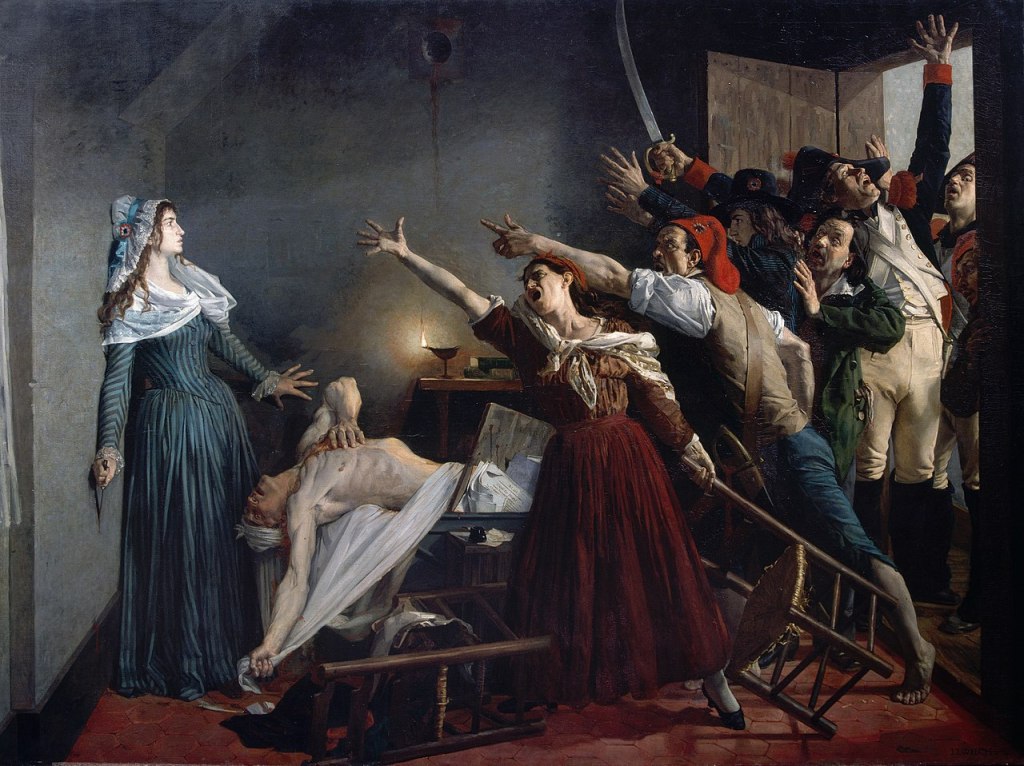
on July 13, 1793. Claiming to have insider information on an attack being led by Girondists, she was refused a few times but like any persistent AF girl with a plan, she continued to ask for entry until she got in. Now Marat had some unknown knarly debilitating skin disease and was pretty much confined to his bathtub, which was where he was seated with a glass of White Zin when Charlotte plunged her 5 inch dagger into his carotid artery, killing him nearly instantly.
“L’assassinat de Marat” The Assasination of Marat. Painted in 1880 by Jean-Joseph Weert
He was able to yell out before he died, thus attracting a crowd of neighbours and friends of Marat to seize Charlotte and take her straight to prison.
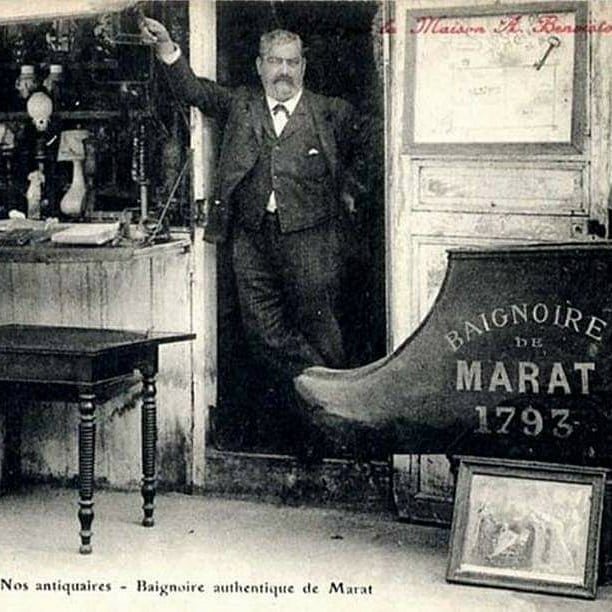
The oddly shaped bathtub Marat was soaking in before he got shanked by Charlotte, today kept at the Musée Grévin
The Death of Marat Jacques-Louis David, 1793
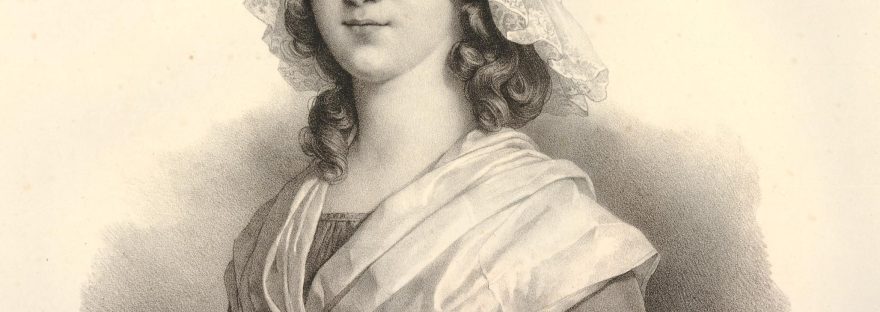
Charlotte was prepared to take one for the Girondin Team and even had a letter neatly prepared explaining why she did what she did. She went calmly to the guillotine on the 17th of July and before she was executed boldly proclaimed “I killed one man to save 100,000.” Badass. Her last request was to be painted.
Charlotte painted by Jean-Jacques Hauer before she was executed
Charlotte’s courageous action radically changed the perceptions of women’s roles at that time when they had no voice to really make a difference. No one could believe that she had acted alone and of her own free will. Insisting a strong male lover had convinced her delicate and impressionable female mind to commit the shocking crime, her body was even examined for evidence she was not a virgin.
To their surprise; she was.
Read the post below to find out Charlotte purchased her dagger.
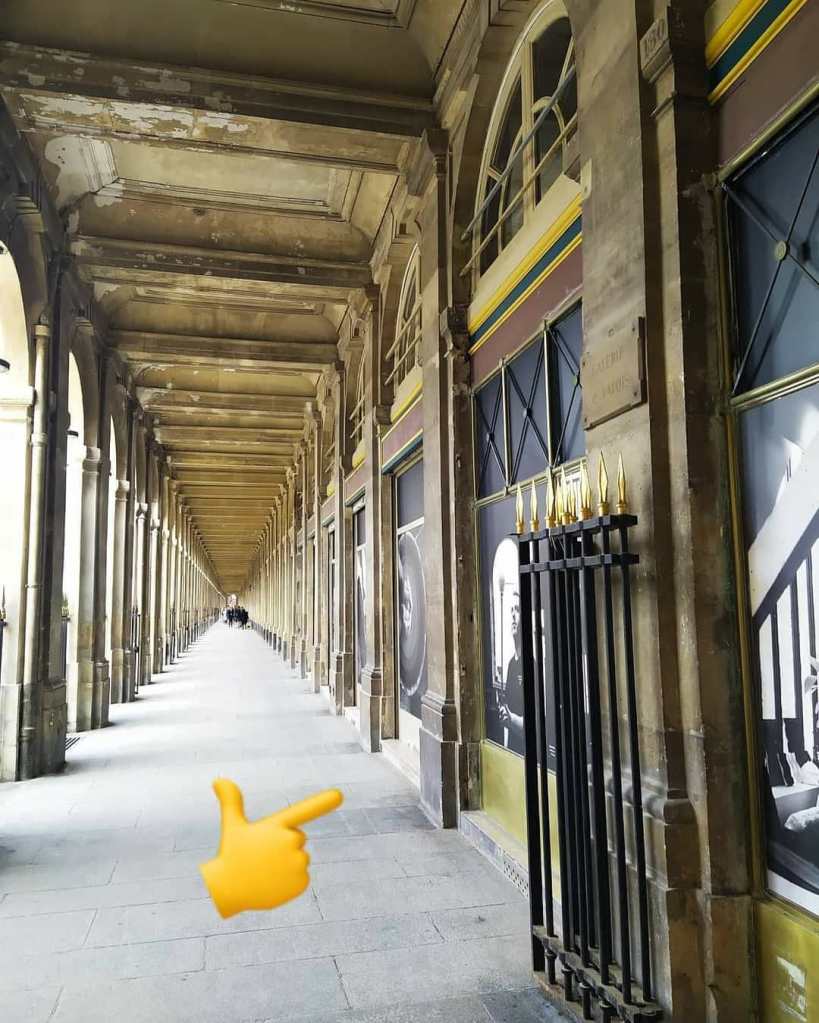
Here’s a little detail about The Martyr Murderess Charlotte Corday (you can catch up on her by reading the link below) most normal people probably wouldn’t be interested in. But I am admittedly morbid, (and you are too if you follow this page right?) so when I read that the dagger she used to murder Marat was purchased in one of the little shops surrounding the Palais Royal- of course I had to know which one!
177 Galerie de Valois today, empty
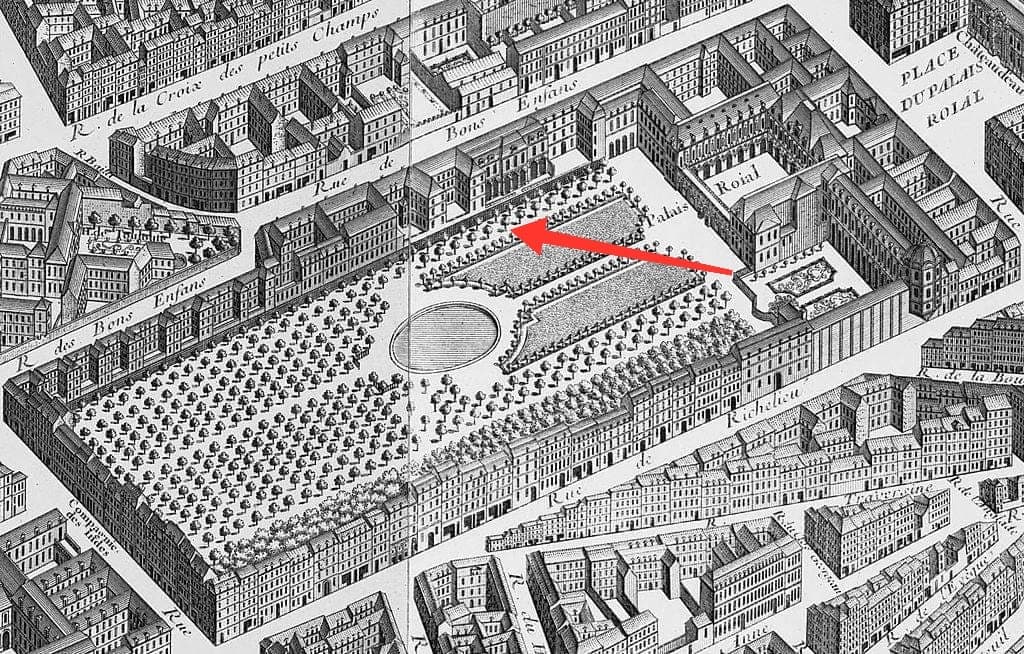
In the galleries surrounding the gardens of the Palais Royal (then known as the Palais de l’Egalité because of strong anti-royal sentiments and such) you can still see this shop where Charlotte bought her murder weapon. It was known in 1793 as a knife shop, Le Coutelier Badin.
Approximate location of the shop where Charlotte purchased the dagger she would use to kill Marat. Turgot map, 1739
According to her testimony, Charlotte purchased the 15cm blade for 40 sous around 8am on July 13, 1793. She then took a carriage to Marat’s home across the river. It took her multiple tries to enter his home that day (both the guardienne of the building and Marat’s companion told her off) but on her 3rd attempt in the evening, she yelled loudly enough for Marat to hear her from his bathroom, insisting she had information for him.
Assassination of Marat, Paul Baudry 1860
And like an 18th century bath ridden Mr. Rodgers, he told her to come on in! The rest is history,.. check out the post below.
















 Paris History of our Streets