Let’s talk deadly epidemics shall we? Tucked away behind the Hotel de Ville (City Hall) is one of those medieval Paris streets that transports you back in time. And since this portion has been around for a solid 800 years, it might be the closest thing we can get to a legit time machine.
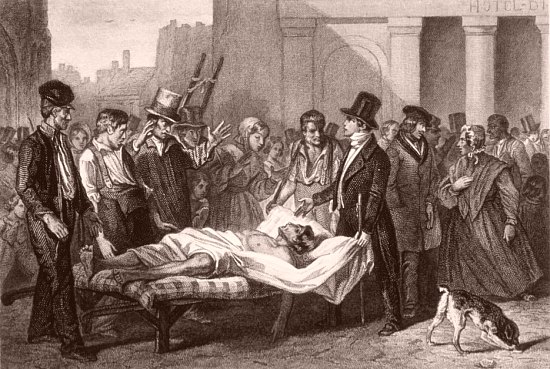
However, you might not want to go back to the year 1832, when Paris was slammed with the Coron.. err Cholera Epidemic.
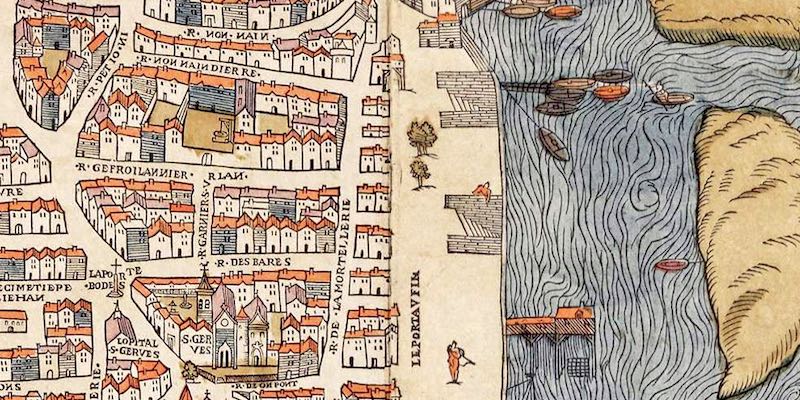
Within 3 months, there would be 19,000 Parisians dead. This street, known at the time as the Rue de la Mortellerie, was hit the hardest. Of the 4,000 people living there, 304 would perish. If you understand French (mort = dead) and are sensitive to bad omens, you might say “Well what can you expect with a name like Little Dead Street?”. In fact, the street was given this name in 1212 (!!) because many stone masons (some of whom dealt with mortar, thus giving them the title Morteliers) worked here.
Rue de la Mortellerie in 1550. Its located in the center, vertically lined
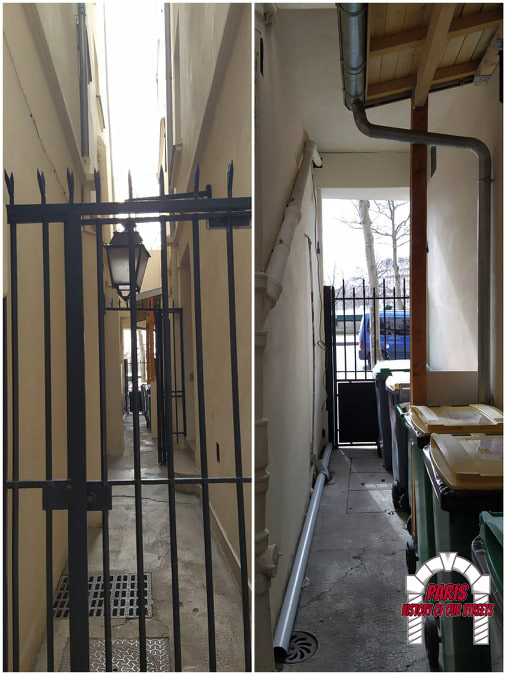
In old Paris, many street names were reflected who lived or worked there. Can you guess what inspired the Rue Tire-Boudin (Sausage Puller)? No, its not a Butcher. You can still see the passage people living here took to reach the Seine for water, Ruelle des Trois-Maures. (More bad Juju, it sounds like Three Dead in French) It’s been blocked off since 1841, but not for THIS GUY.
No Barrier Can Hold Me Back from HISTORY!(Not much to see except for garbage cans)
So anyways, post-epidemic, the inhabitants of this street petitioned to change the name of their street to something less macabre. In typical Paris admin fashion, it only took the city 3 years to agree and in February 1835 this street was dubbed Rue de la Hotel de Ville.
Rue de la Mortellerie in the 18th century, the orange arrow indicates the Ruelle des Trois Maures
The street was mostly razed 1914 but a few remarkably old buildings still exist at the very end. You can still see the former name Rue de la Mortellerie carved in stone above number 95.
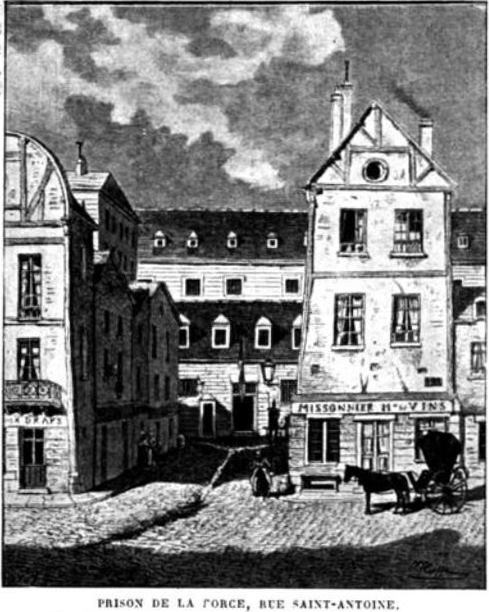
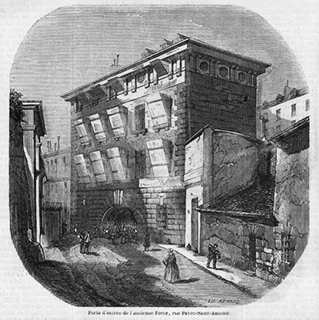
I think we can all safely say that finding one’s self in a medieval prison would not be ideal (unless you were one of the 7 lucky released inhabitants of the Bastille prison on the 14th of July 1789) but the Force prison was truly the exception for its level of disease and decay. The 18th century prison was described by Victor Hugo as being so rotted that “the ceilings had to be covered in wood so that falling stones would not kill prisoners in their beds” (Les Miserables). Charles Dickens depicted the Force as “a gloomy prison, dark and filthy, and with a horrible smell” (A Tale of Two Cities).
Originally a 16th century palace King Louis IX’s brother, the building would be converted to become a model prison where criminals went to be rehabilitated, (by the order of Louis XVI himself in 1780). The prison was separated in two parts; The Petite Force for women, and the Grand Force for men.
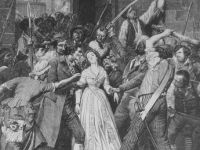
However, when the Revolution came along in 1789, the prison quickly became overpopulated and conditions went downhill faster than a fart in the wind. In early September 1792; 408 prisoners were examined for crimes against France. About 169 of them would be executed, including the savagely murdered Princess of Lamballe- BFF of Marie Antoinette, which you can read about in the attached post below if you have the stomach for it.
The Force prison was destroyed in 1845, and only a single wall of the Petite Force remains, just next to the History of Paris library (Hotel Lamoignon).
1910 Atget
The prison itself occupied the space that Is today between Rue du Roi Sicile, Rue Pavée, and Rue Malheur (see the blue line in the photo, this street did not exist at the time of the prison).
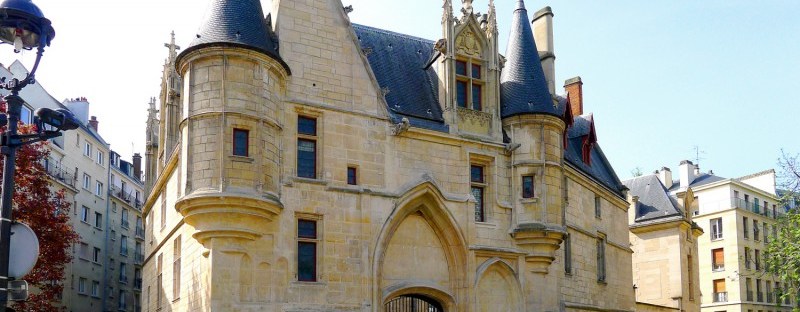
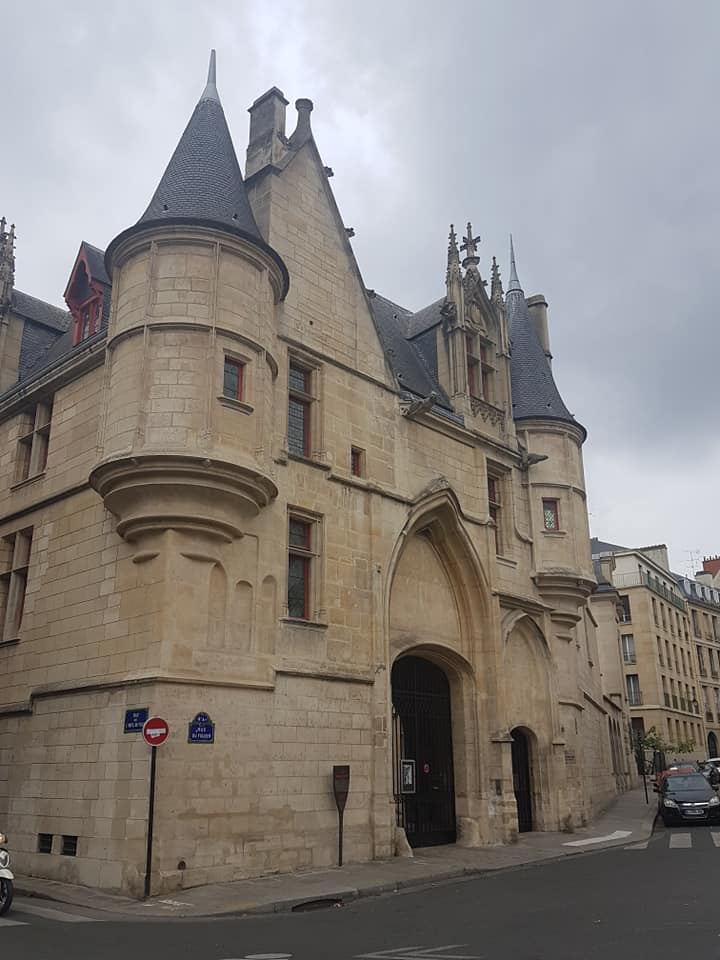
The Marais district of Paris is a goldmine of old buildings and history. The Hotel de Sens, which is situated next to the Seine- has the honor of being one of the oldest original gangstas of flamboyant Gothic Paris architecture still standing.
Before it came to be known as the LGBF/Jewish quarter of Paris, this area was home to French royalty and the medieval palace of Saint Pol, which was eventually demolished when the Louvre became the official digs of Kings.
Map of the Marais in 1450. You can spot the original Hotel de Sens a bit to the left of the green circle indicating the Hotel Saint Pol
The Hotel de Sens we know today was built from 1475 to 1519 by Tristian de Salazar as the residence for the Archbishop of Sens. Now, what the hell is an archbishop you ask? There’s a lot of boring religious vocabulary to sort through to understand this, but to dumb it down for my special readers, here’s a little summary I’d like to call RELIGIOUS CATHOLIC HIERARCHY VOCAB MADE EASY – to start with, we got the head honcho- THE POPE, elected by God and the College of Cardinals. Now the title of POPE is just a fancy way of saying the Bishop of Rome, who controls all the other bishops/archbishops thus leading the Catholic Church. (You still with me?) So since the 2nd century, in the Roman Catholic church; each geographical area is divided into a diocese/archdiocese, which is controlled by either an Archbishop or Bishop. An Archbishop has an Archdiocese of importance, where a Bishop simply controls your regular Joe Shmoe diocese. This is just the basics, there’s obviously more finer details but I don’t want to bore you to death.
ANYWAYS, back to 16th century France- Paris wasn’t a big enough hotshot in the Catholic community to be its own Archdiocese, so it was under the jurisdiction of Sens; which is a quaint city about 100km south-west of Paris. The Archbishop of Sens had his main digs in Paris until 1622 when Paris took over the Archdiocese reigns, thus reducing the power of the Archbishop of Sens who eventually handed over ownership of the hotel to the new Archbishop of Paris Jean-Francois de Gondi, who preferred to reign over Paris elsewhere.
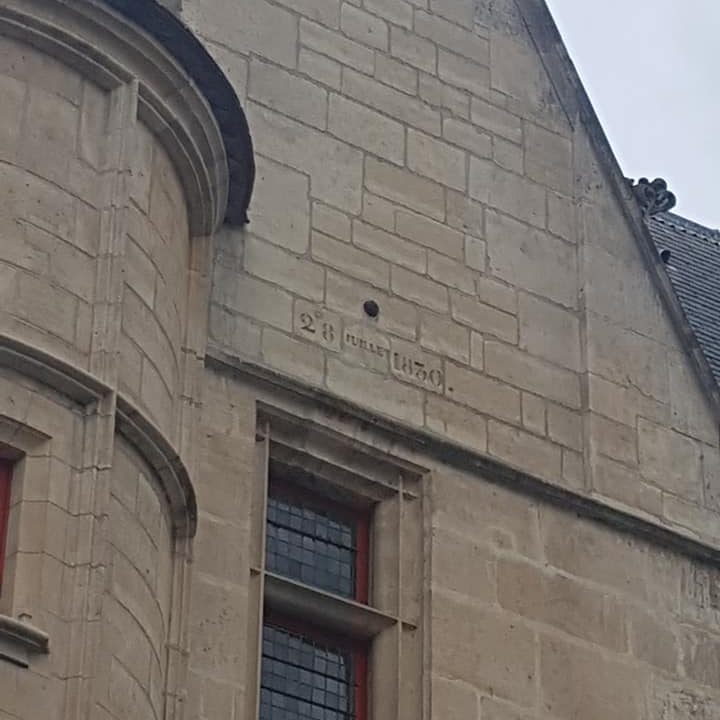
The Hotel was then rented to wealthy nobles before it became national property in 1790 at the start of the French Revolution. One remarkable thing to take note of is the rather unremarkable cannonball embedded into the façade of the hotel.
I admit my cannonball knowledge is subpar at best, but this guy seems a little.. small?
This is from the July Revolution of 1830 AKA the 2nd less carnal but still pretty bloody French Revolution where the people overthrew the government and King Charles X. They besieged the neighborhood area of the Hotel de Ville and shot cannonballs into the old royal part of the city. How one of these iron ballz found itself embedded here, I don’t know- but it was gracefully preserved, maybe to remind Parisians that it ain’t cool to attempt to destroy your own history.
Inner courtyard
The Hotel de Sens stubbornly remained standing throughout the 19th century and was home to various factories, including one that fabricated jam. It was declared a national historical monument in 1862 and eventually bought by the city of Paris in 1911, who financed restorations in the 1930’s. Today, the Hotel de Sens houses the Forney Library, a research library dedicated to decorative and graphic arts.
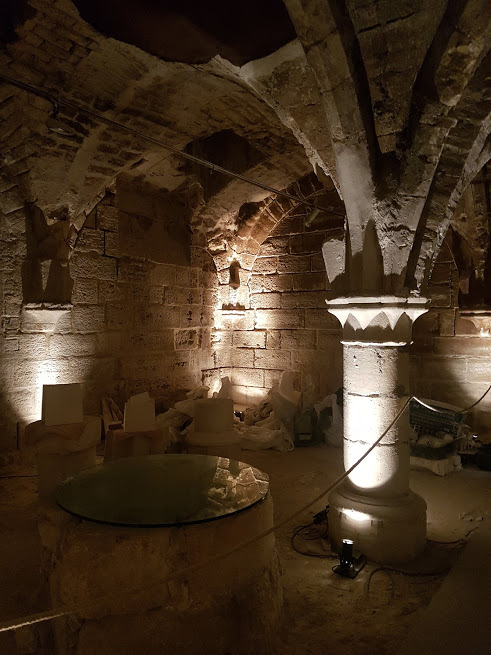
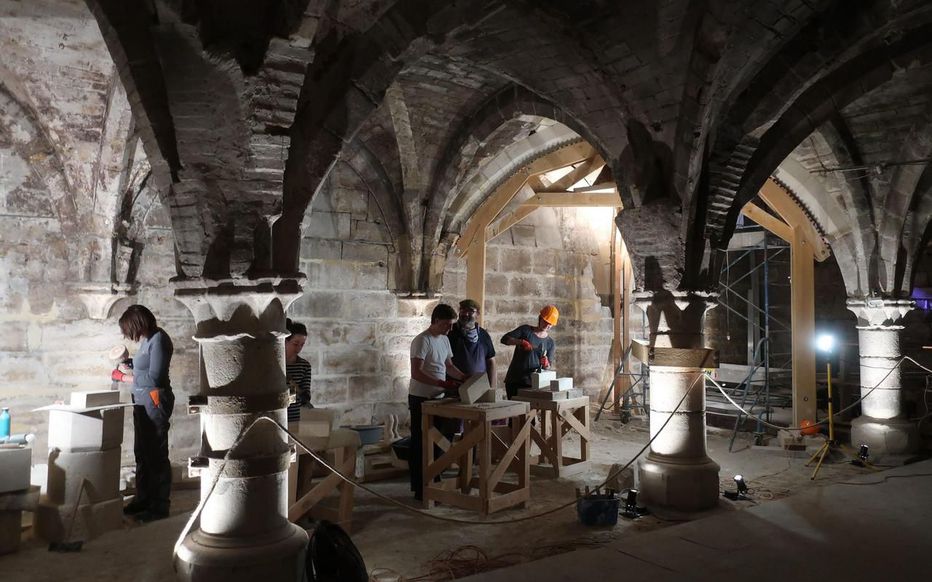
During an exceptionally hot Paris weekend in June 2019, I was in a sweater and hard hat, assisting in the restoration of a chilly 13th century cellar in the heart of the Marais district in Paris.
I have no business handling power tools
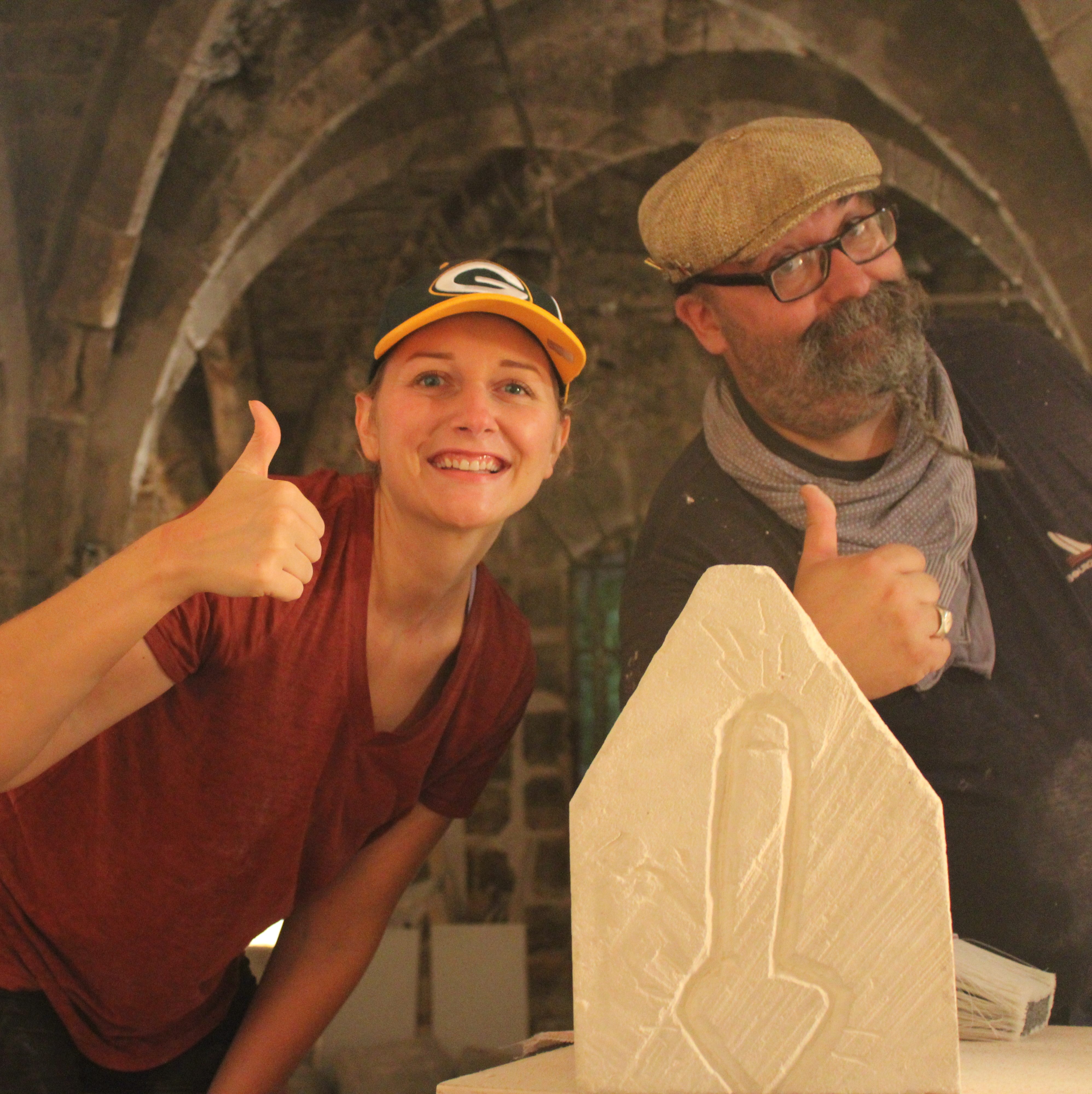
Taken under the bearded wing of the coolest medieval expert stone mason David Poiron, I spent all weekend in heavy-duty gloves chiseling away at limestone blocks and destroying chunks of a vaulted archway that was to be restored. I probably inhaled a whole lot of 700-year-old gravel, but being in the company of other like-minded fans of history for an entire weekend was pretty incredible.
Stone Maison Extraordinaire David
Armed with blunt and heavy tools I have no business handling, my mission that weekend consisted mostly of Bitch Work I was happy to be delegated due to my lack of stone cutting skills, like chiseling ridges in heavy blocks. These cumbersome but necessary ridges, made using iron wide toothed chisels, served to help the paint stick better to the stone it was placed against. Each of these blocks had a particular shape carved into each side; also to help the bonding agent to adhere better than being up against solid smooth stone.
And because the cellar is a historically protected site, you can’t just throw these guys in a machine to be spat out 30 seconds later perfectly shaped. Any work done here has to be done the same way it was originally done, with the same tools, materials, and methods. This is one reason why rebuilding Notre Dame cathedral is so complicated; much of the wood used to create the roof doesn’t exist anymore. The block I worked with that day will eventually be used to create a new identical rib for a damaged vault.
AND GUYS GUESS WHAT, as destiny would have it, the first stone I chose to shape already had been touched by a former cheeky stone mason who might have been my soul mate. In addition to a borderline perverse and immature sense of humor, this mysterious personage was also mathematically correct. Because this design will be fitted against an exact replica on another block and filled with glue it won’t be seen, so anyone clutching their peals can just relax.
As David pointed out to me in between my sporadique giggling fits, the phallus was carved using the Golden Ratio. So what is that? Well its super fucking cool that’s what. A mix of science and evolutionary psychology, the GR is the comparison of any two aspects, often using body parts that have the same ratios, on EVERYONE, that leads us to proportion them in the ideal way.
PERFECTION
Try to follow as I explain while being as politically correct as possible. The measurements from lower nut sac to dick hole were identical to the distance between my pinky finger tip and thumb finger tip. From exterior left ball to the right ball, my index finger was an exact match. One could say deez nuts are perfect, in the eyes of God.
The 13th century gothic cave of the Maison d’Ourscamptoday
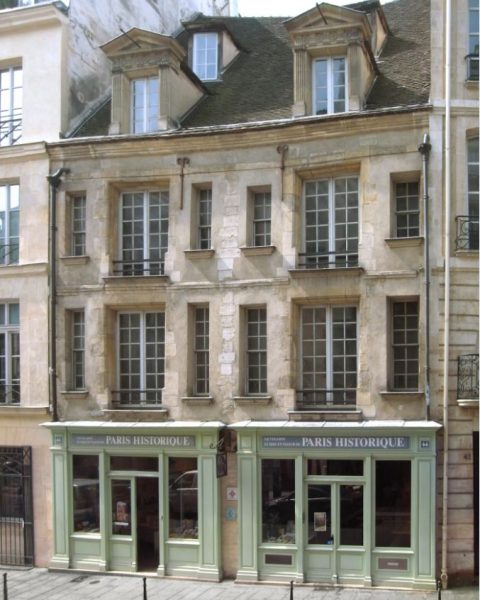
If you are in Paris, you can check out the cellar and its building for yourself at l’Association Paris Historique 44-46 rue François-Miron in the 4th arrondisement. They have been in the process of restoring this cellar since the 60’s, which was once part of a building belonging to 13th Cistercian monks before that building was demolished, and the current one put in place in the 15th century, right on top of the old one, leaving the cellar in need of some TLC but intact.
Napoleon Bonapartre or Napoleon Born2Party? History’s favorite not-so-little General had a hot and steamy sex life with his first wife Josephine (look up their raunchy love letters if you want to read 18th century smut lit.) but we can thank a certain Mademoiselle Deschamps for making a man out of the scrawny 18 year old with greasy hair and thick Italian/Corsican accent.
In November 1787, teenage Napoleon came to Paris to finish military training. He must have been lonely because one evening he left his hotel on the rue du Four-Saint-Honoré and wandered around the Palais Royale neighborhood, which was the equivalent of a bourgeois red light district at the time.
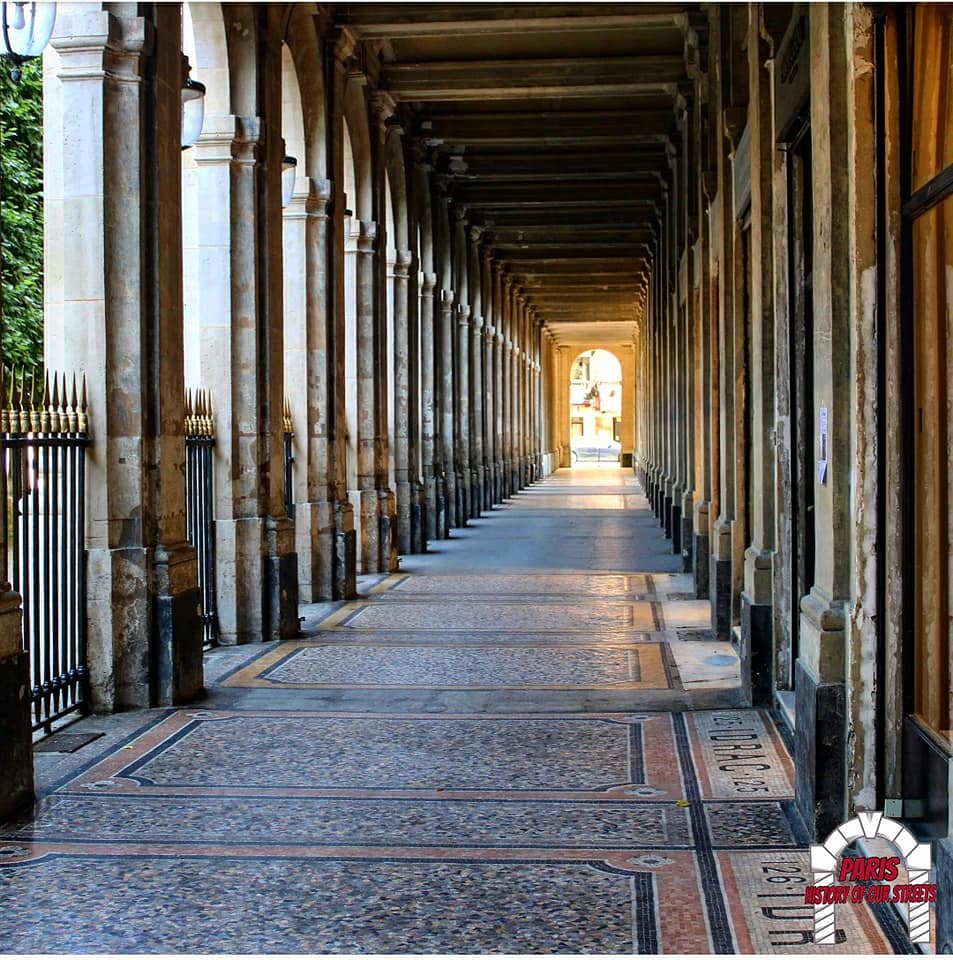
The Galleries of the Palais Royal where Napoleon once wandered…
He later would write in his journal about “The First Time”. Here is my personal translation of these events set in a 21st century dialogue.
Thursday November 22, 1787 Hotel de Cherbourg, rue du Four-Saint-Honoré: So there I was, walking around kicking rocks in the Galleries of the Palais Royale when I spot a really pathetic looking hooker. She was pale and thin and barely a teenager but her awkwardness at playing an adult was kind of a turn on. I asked her how she wasn’t freezing her ass off in that crop top and was pleased to find her a little shy but easy to talk to. We started shooting the shit, talking about her hometown of Nantes and how she found herself in this line of work (“she was taken advantage of by a soldier. Then another, who took her to Paris. Then another who she lived with for 3 years but it didn’t work out because he was two timing her with an English lady) and why she didn’t do something else (“Embroidery and babysitting ain’t gonna pay my bills. Heels and hustle baby”). She suggested we go back to my digs and I played dumb, asking her what we would do. She replied “We will warm up and then play butt games”. Now I’m normally not much of a spontaneous guy, but considering my failure to successfully seduce a woman up until this point, I figured what the hell, why not. It was now or wind up a 20 year old virgin!“
The location of Rue Vauvillier today
The red arrow points to the approximate location of where Napoleon’s hotel would have been before it was destroyed along with half the street to make space for pavillions 1 and 2 of a historic giant centralized outdoor market. Destroyed in the 1970’s, the market became the huge outdoor area we see today, conceiling a giant shopping complex and underground transport hub.
Napoleon stayed at this hotel for several months and was described as shy, awkward, and a little sad. He signed his name in the register using the Italian-ized Napolione Buonaparte. According to the owner, he only left his room (3rd floor, room #9) for meals which he took at a nearby deli.
The very room where Napoleon lost his virginity
The hotel was destroyed in 1914 and the portion it was on razed to create pavillons 1&2 of the old Les Halles centralized Paris markets. Today the street is named Rue Vauvilliers and the exact placement of where Napoleon lost his V card is located in a children’s park. Napoleon didn’t leave us any further juicy details of this important life event but he did grow out of his awkwardness not long after. Only 17 years later he would declare himself Emperor of France. You can read the original diary entry transcript here. https://www.napoleon.org/…/une-rencontre-au-palais-royal/



















 Paris History of our Streets